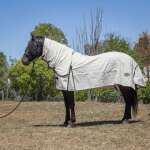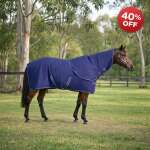


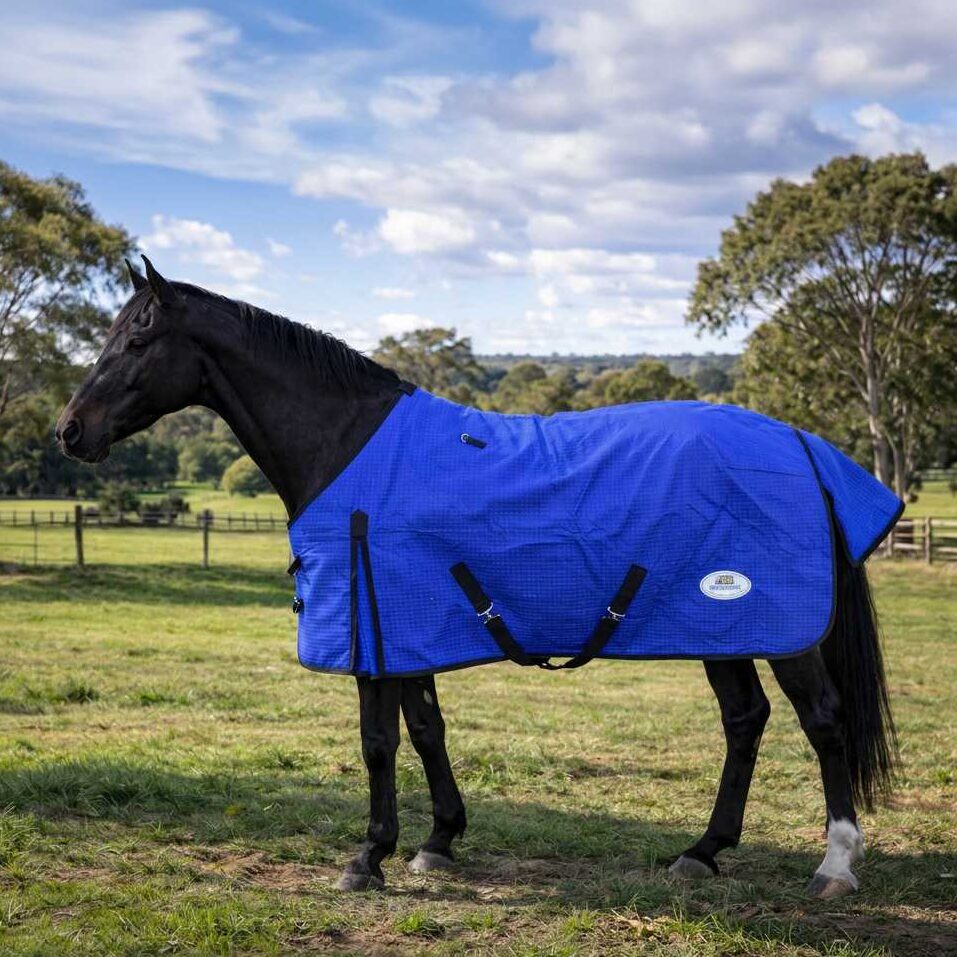
TL;DR — A “combo” covers the neck plus body. A “rug” is body-only. The combo wins on wind, rain and mane-management; the rug wins on summer evenings, easy paddock-fitting, and horses that hate things over the head. For most Australian winters, a medium combo is the safer default — but plenty of horses don’t need the neck cover at all. Below: when each one is right, when it isn’t, and the WHWH rug and combo pairs you can pick from depending on which way you go.
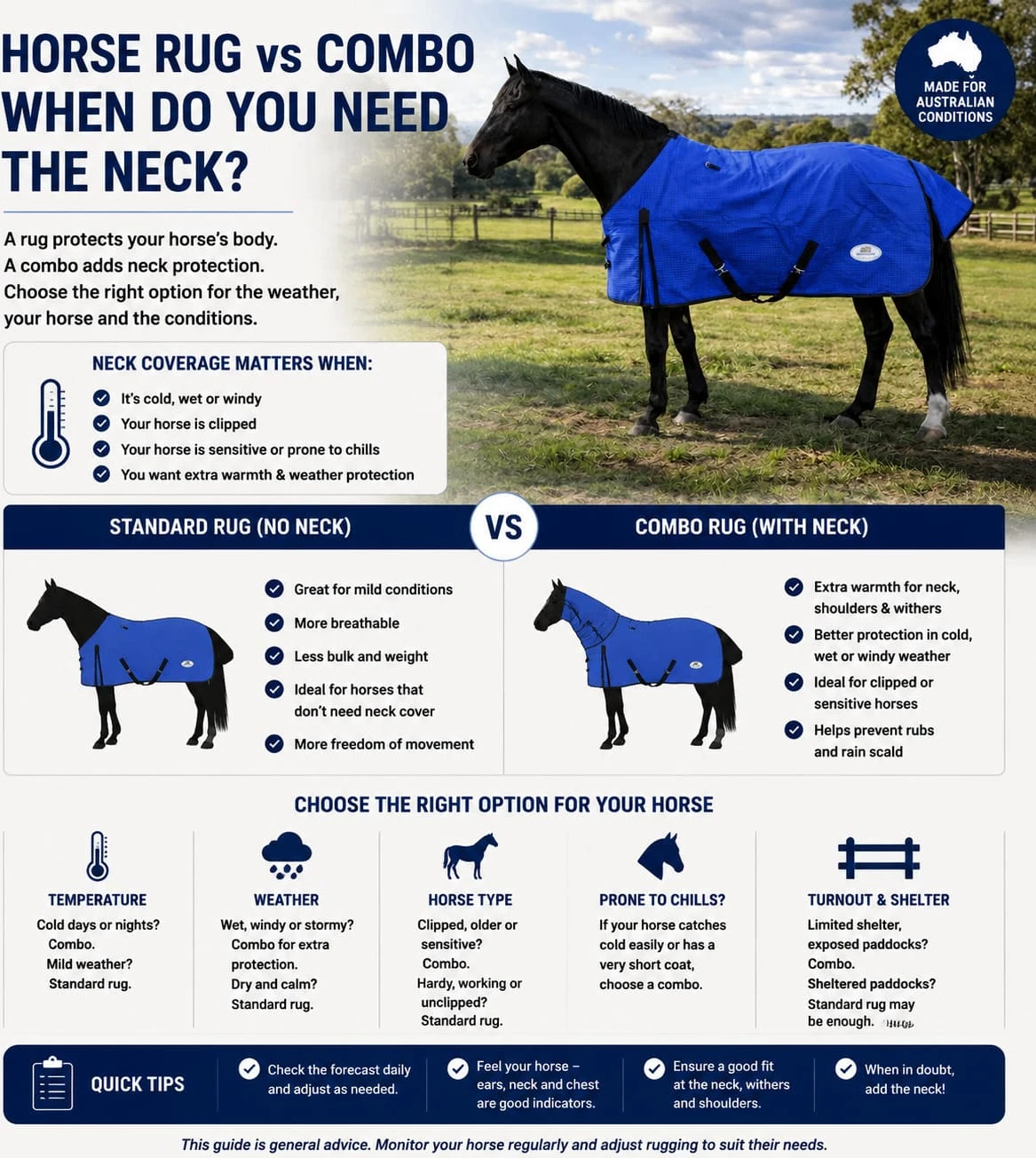
The literal difference — what a combo adds
The naming is genuinely that simple. A rug is the body section: a rectangular blanket that sits from the withers to the tail, fastened by chest buckles, a belly surcingle and leg straps. A combo is the same body section with an attached neck cover: a hooded extension that runs from the wither line up to the poll, fastened at the throat. The combo also tends to carry a longer chest extension and a closer wither fit, because once the neck is enclosed you don’t want a cold draught funnelling down the back.
Two practical consequences fall out of that one design difference:
- The combo covers more of the horse’s heat-loss area, so it keeps warmth in better than a body-only rug of the same fill weight.
- The combo is harder to put on and take off — especially in a paddock, especially on a horse that doesn’t love things going over its head.
Everything that follows is downstream of those two facts.
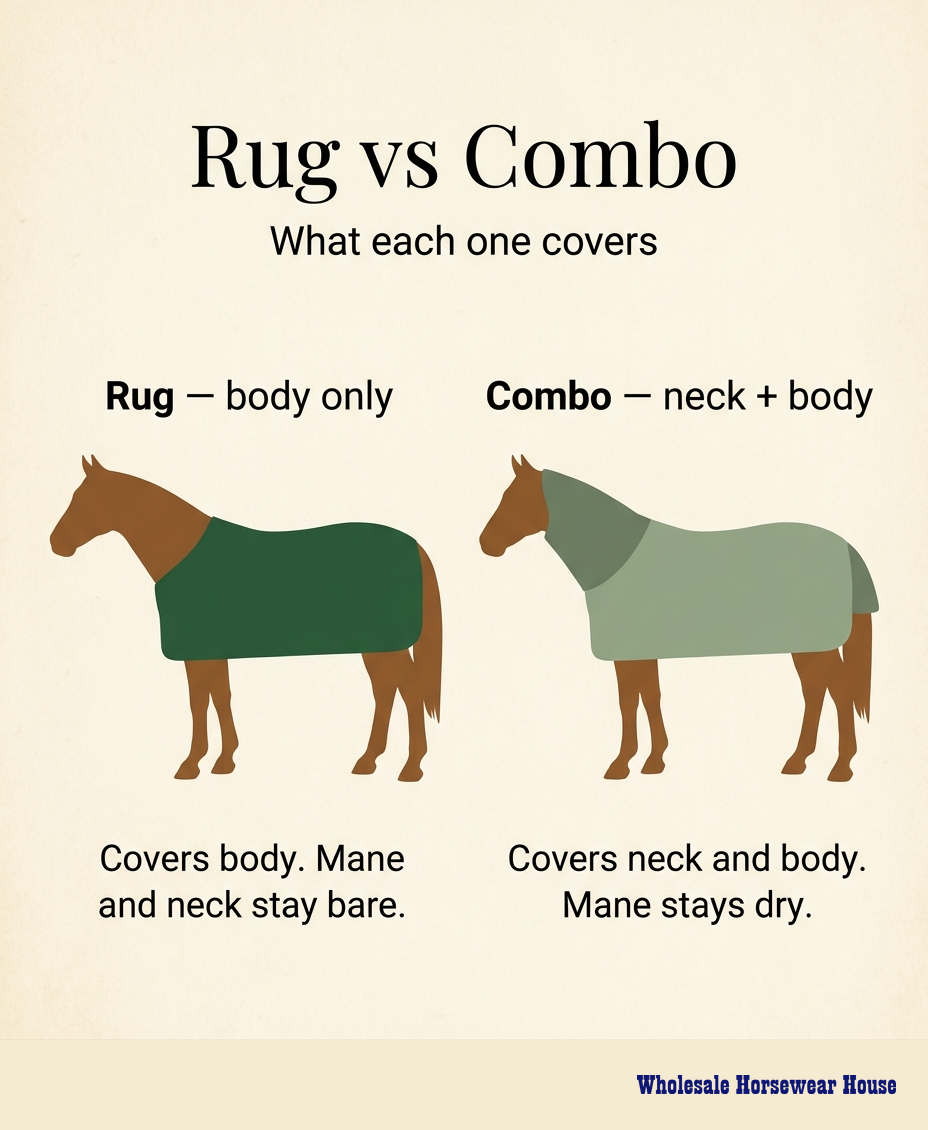
When the combo earns its keep
A combo earns the extra fitting effort when one of four things is true on the night the rug goes on:
- The forecast is wind-driven, not just cold. Wind chill is the silent driver of overnight heat loss. A still 4°C paddock isn’t the same as a 4°C paddock in 30 km/h southerly. The Bureau of Meteorology’s climate zone material is the reference point for what your part of Australia tends to throw at you overnight — cold-temperate and frost-belt zones get the wind variable on top of the temperature variable. A combo seals the chest-and-shoulder seam against that wind in a way a body-only rug can’t.
- Rain is sustained, not just drizzle. A rug keeps the spine and barrel dry. A combo keeps the neck and mane dry too. Wet manes against wet skin under a heavy rug is the start of rain scald along the crest — one of the avoidable winter problems Equestrian Australia and Horse SA welfare resources flag for owners.
- The horse is clipped. Clipped horses lose roughly twice the body heat of unclipped horses at the same overnight temperature, because the natural winter coat that does most of the insulation has been removed. Anything from a trace clip up needs full-neck cover from the rug if it’s in a frost belt or cold-temperate paddock.
- Frost is forecast. Sustained sub-zero overnight temperatures — the kind Stanthorpe, Glen Innes, the Monaro, Tasmanian highlands and the Vic high country deliver from June through August — need the combo’s closed neck. A medium-fill combo over an unclipped horse on a −3°C frost morning is doing the job a heavy body-only rug can’t.
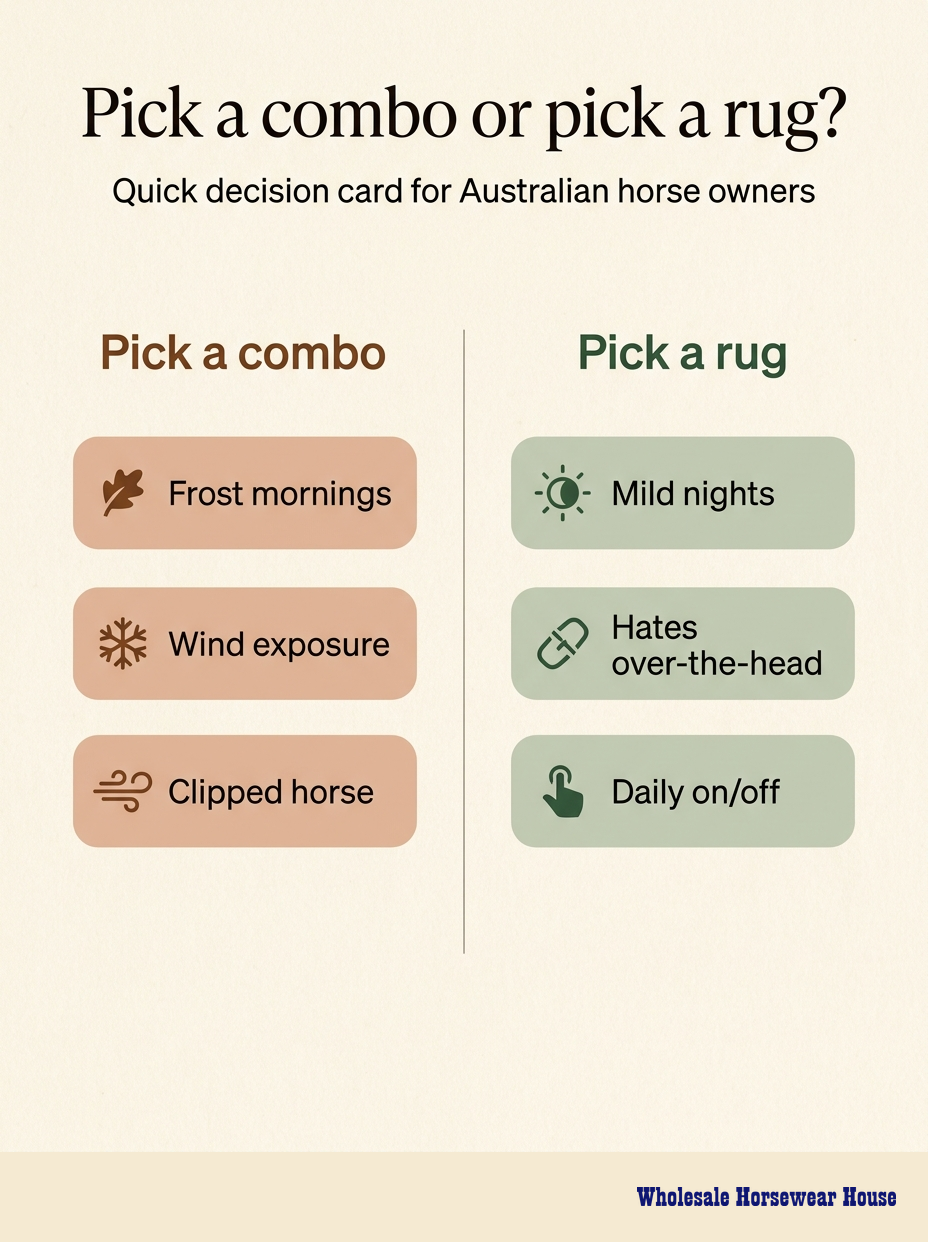
When a body-only rug is plenty
The body-only rug isn’t a compromise — for a big chunk of Australian horses it’s the right answer. The honest list of conditions where a rug beats a combo:
- Still, mild nights. Subtropical and warm-temperate zones — SE QLD, the NSW coast, Perth, Adelaide — deliver most of their winter as still 6–12°C overnights. An unclipped horse on a still 8°C night with a body-only medium rug is comfortable, sweat-free, and dry under the lining in the morning.
- Reliable shelter access. If your paddock has a real run-in shed, a treeline, or anything else the horse can put its tail to when the weather turns, the neck cover stops being a thermal essential and becomes a nice-to-have.
- Horses that hate things over the head. Some horses — particularly ex-racers and any horse with a poll injury history — will fight a combo every single evening. Pony Club Australia’s rider guidance is direct on this: the rug your horse will actually let you put on is worth more than the rug that’s technically warmer. A body-only rug slides over the wither cleanly without anything passing the head.
- Daily on/off paddock routine. A combo takes a minute longer at every fitting. Across a winter that’s an hour you could be feeding, hosing legs, or fixing fences. Working-stable owners with a dozen rugs to swap every morning often run body-only rugs through the milder weeks and only switch to combos when the forecast changes.
- Stable-only horses. If the horse lives under cover all night, every night, you’ve already taken wind and rain out of the equation. A medium body rug plus a separate neck cover when you want one is a more flexible kit than a combo you can’t easily peel apart.
If the picture above sounds like your paddock, look at the body-only side of our range: the Highlander Quilted Rug, the Simpson Lined Rug, the Stradbroke Jute Rug, or the Sunny Plus Rug — depending on season and fill weight.
Side-by-side — how rug and combo actually compare
The seven things that change when you add the neck cover — on the same shell, the same fill weight, the same horse:
Rug vs combo — the seven differences that matter
Same shell, same fill, same horse — only the neck section changes
The mane-and-tail mess argument
This is the argument we hear from working trainers more often than the welfare one. A combo keeps the mane dry. A body-only rug does not. Through a wet Toowoomba or Hunter Valley winter, the practical consequence on a long-maned horse is roughly this:
- Wet mane sits against wet skin on the crest of the neck for the whole night.
- Morning brings clumped, knotted, sometimes-musty mane that needs a half-hour of patient detangling.
- Over weeks, the crest line under a perpetually-wet mane is the first place rain scald starts — the small scaly lesions the RSPCA welfare material flags as a wet-weather problem in unsheltered horses.
- For show horses, an undamaged mane is half the job. A combo through winter is the difference between presenting in spring with a thick, intact mane and presenting with a thin, patchy one.
For working stables that spell horses out, the time saved on morning grooming alone usually justifies running combos through the wet months. The Highlander Quilted Combo and the Simpson Lined Combo are the two we ship most often into Australian stable yards for exactly that reason.
Walking the combo on and off in a paddock
The single biggest reason people who’d benefit from a combo end up buying a body-only rug instead is the head-over fitting motion. It’s solvable. The practical method, used by stable hands who put combos on a dozen horses every evening:
- Fold the neck section back over the body of the rug so you’re carrying it as if it were a body-only rug.
- Slide it over the wither in the usual motion — nothing yet goes near the head.
- Fasten the chest buckles loosely so the rug is held in place.
- Now unfold the neck section forward, gently, and slip it over the head from behind. Horses who hate the “dropping from above” motion are usually fine with the “sliding from behind” one.
- Tighten the chest, fasten the throat closure, do up the belly surcingle and leg straps.
The other half of the fitting story is the throat closure itself. A throat strap that’s too tight rubs the underside of the jaw raw within a week. A throat strap that’s too loose lets cold air down the neck and defeats the purpose of the combo in the first place. The University of Sydney School of Veterinary Science material on equine comfort is unambiguous: a flat hand should slide easily between the throat strap and the horse’s throat — not a fist, not a fingertip.
The WHWH rug-and-combo pairs — pick the format that fits your paddock
Most of our serious paddock rugs ship in both formats. You don’t have to choose a brand based on a feature you may or may not need — you pick the shell, the fill weight and the format separately. The three most-sold pairs across the WHWH winter range:
Three GTL pairs — rug and combo of the same shell
Same fabric, same fill, your choice of body-only or full neck
Quilted shell
Highlander Quilted
Our most-shipped winter pair. Medium fill, quilted lining, available as body-only or full combo. The default for paddock horses in cool-temperate Australia.
Ripstop shell
Simpson Lined
Heavier 1200D ripstop shell with mid-weight lining. The combo most racing stables choose for paddock spelling; the rug suits horses that fight head coverage.
Heritage jute
Stradbroke Jute
The unlined Aussie jute weave, designed to breathe and shed water rather than insulate. Available as rug, combo, or detachable neck rug if you want to mix and match.
Outside those three pairs, the heaviest end of the range is combo-only for a reason — if the conditions warrant a 300g+ arctic-rated rug, they also warrant the neck cover. The Arctic Combo and Arctic Rug, Husky Combo, and Woodland Combo are all weighted for genuine frost-belt and alpine paddocks. The Woodland Hood and Horze Nevada Stable Neck Rug are the add-on neck pieces when you’ve already got a body rug and want to layer up rather than buy a whole new combo. For summer fly cover, Sunny Plus in both rug and combo form is the lightest pair we make — combo gets the fly coverage right up the neck on a horse that hates being bothered.
Browse the full winter horse rugs category if you want to see every combo and rug option side by side.
What to look for in a combo neck section
Not every combo is built equally well. If you’re upgrading from a rug to a combo, or buying your first one, four things to check on the neck section before money changes hands:
- Gusset depth at the shoulder. The shoulder gusset is the wedge of extra fabric sewn in between the body and the neck section. A shallow gusset binds when the horse drops its head to graze; a deep one moves with the shoulder. If the combo doesn’t have a visible gusset where the neck meets the body, walk away.
- Throat closure type. The cleanest design is a single adjustable strap with a quick-release buckle — not a velcro tab (wears out) and not a fixed-length strap (won’t fit two horses). The strap should sit flat against the throat with no twist.
- Neckline darts at the poll. A flat-cut combo bunches behind the ears. A combo with two small darts shaped into the poll line sits flush. Run your hand from the poll backwards along the neck — if you can feel a fold of fabric, that’s the bunch point that will rub through winter.
- Lining at the wither. The wither is the highest pressure point on the whole rug. A combo with a soft taffeta or fleece liner across the wither line keeps the hair smooth; a combo with raw quilted lining there will rub a bald spot inside a fortnight on a horse with prominent withers.
The Australian Horse Industry Council’s ownership guidance is consistent on this point: rugs and combos are tools, and the difference between a tool that helps and a tool that harms is fit and finish, not price tag. A well-built combo on the right horse outlasts two poorly-built ones every time.
The Wholesale Horsewear House promise
We’re a family-run saddlery on Alderley Street, Toowoomba, founded by Geraldine Lalor in 2005. We design the GTL rug range ourselves, ship Australia-wide, and we make both rugs and combos of almost every shell so you’re never stuck choosing a feature you don’t need just to get the shell you do. If you’re not sure which way to go for your horse and your paddock, phone us on (07) 4613 5599 — we’ve been measuring up Australian horses since 2005, and we’ll talk through the options without trying to sell you the most expensive rug on the page.
Free postage on every order over $500. Drop into 528 Alderley Street if you’re nearby — Mon–Fri 8:30am–5pm, Sat 8:30am–12pm.
Related reading
What weight horse rug do I need? An Australian climate guide
Once you’ve picked rug or combo, the next decision is fill weight. The full light/medium/heavy/arctic breakdown by Australian climate zone, with the WHWH rugs that fit each one.
How to measure your horse for a rug
Centre-of-chest to centre-of-tail, around the widest part of the shoulder — the only measurement that matters, and the four things people get wrong when they take it.
Sunshade vs fly mesh combo — what works in an Aussie summer
The summer cousin of this article. Sunshade and fly mesh are both combo-format choices most of the time — the same neck-or-no-neck decision, in 30°C instead of 3°C.
Belly band combos — when do you need the extra coverage?
The third coverage decision after rug-vs-combo: do you also need a belly band? Wind-exposed paddocks, sensitive bellies, and the GTL combos that come with belly bands built in.
Sources
- Bureau of Meteorology — Australian climate classification map
- RSPCA Australia Knowledgebase — horse welfare guidance
- Equestrian Australia — peak national equestrian body
- Horse SA — state horse industry body
- Australian Horse Industry Council — ownership and welfare guidance
- Pony Club Australia — rider and horse care resources
- University of Sydney School of Veterinary Science — equine clinical reference
Guidance in this article reflects the typical experience of Australian horse owners across the WHWH customer base and is intended as general information for unclipped horses in normal body condition. Individual horses vary — clipped horses, older horses, horses recovering from illness, sensitive-skinned horses, and horses housed differently may need a different approach. If your horse fights neck coverage or has a history of poll injury, speak with your equine vet or call us on (07) 4613 5599 and we’ll talk you through it.