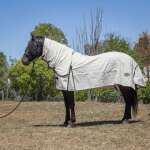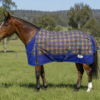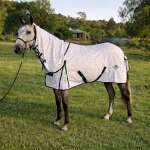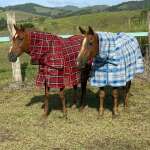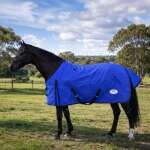


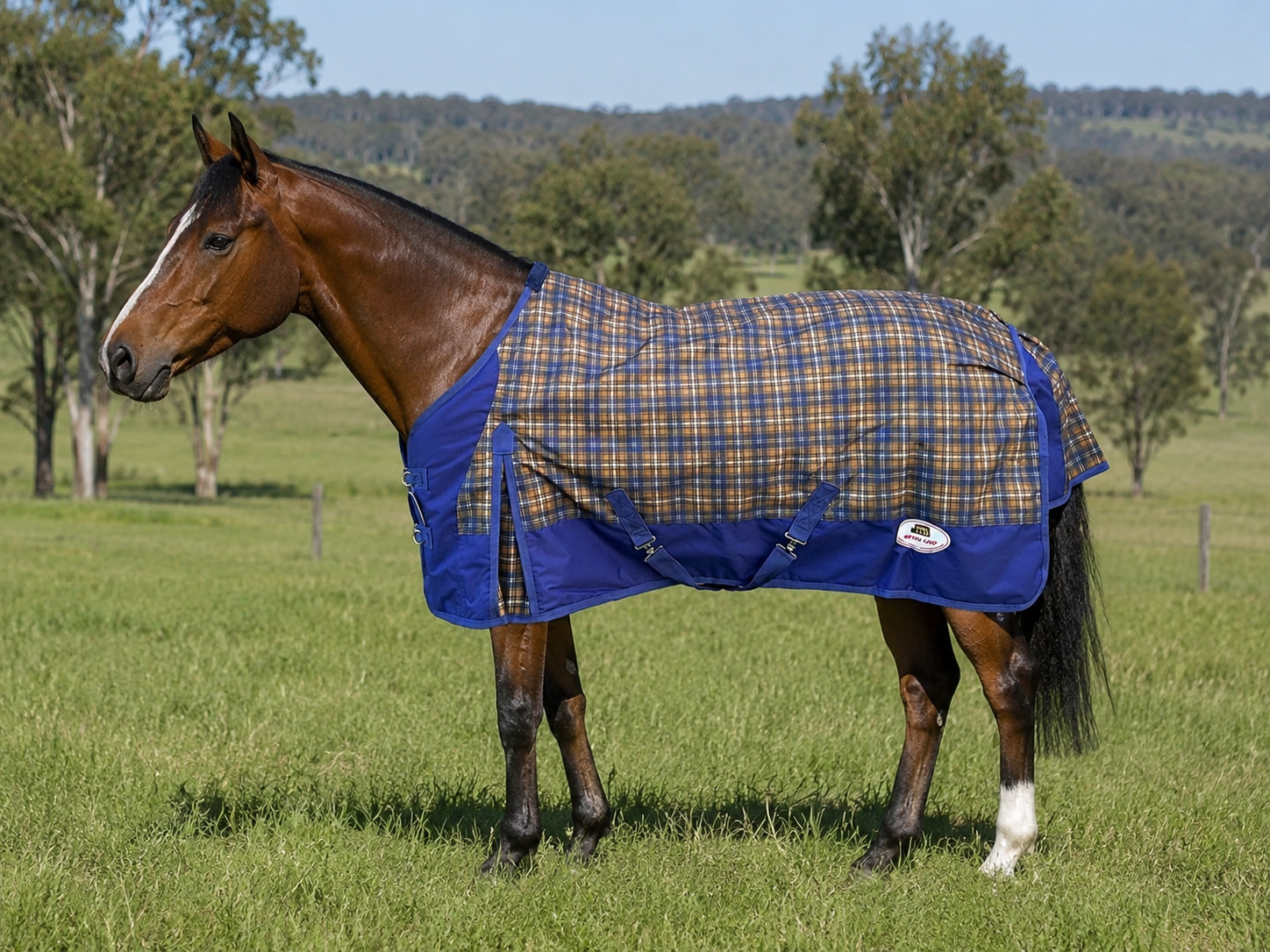
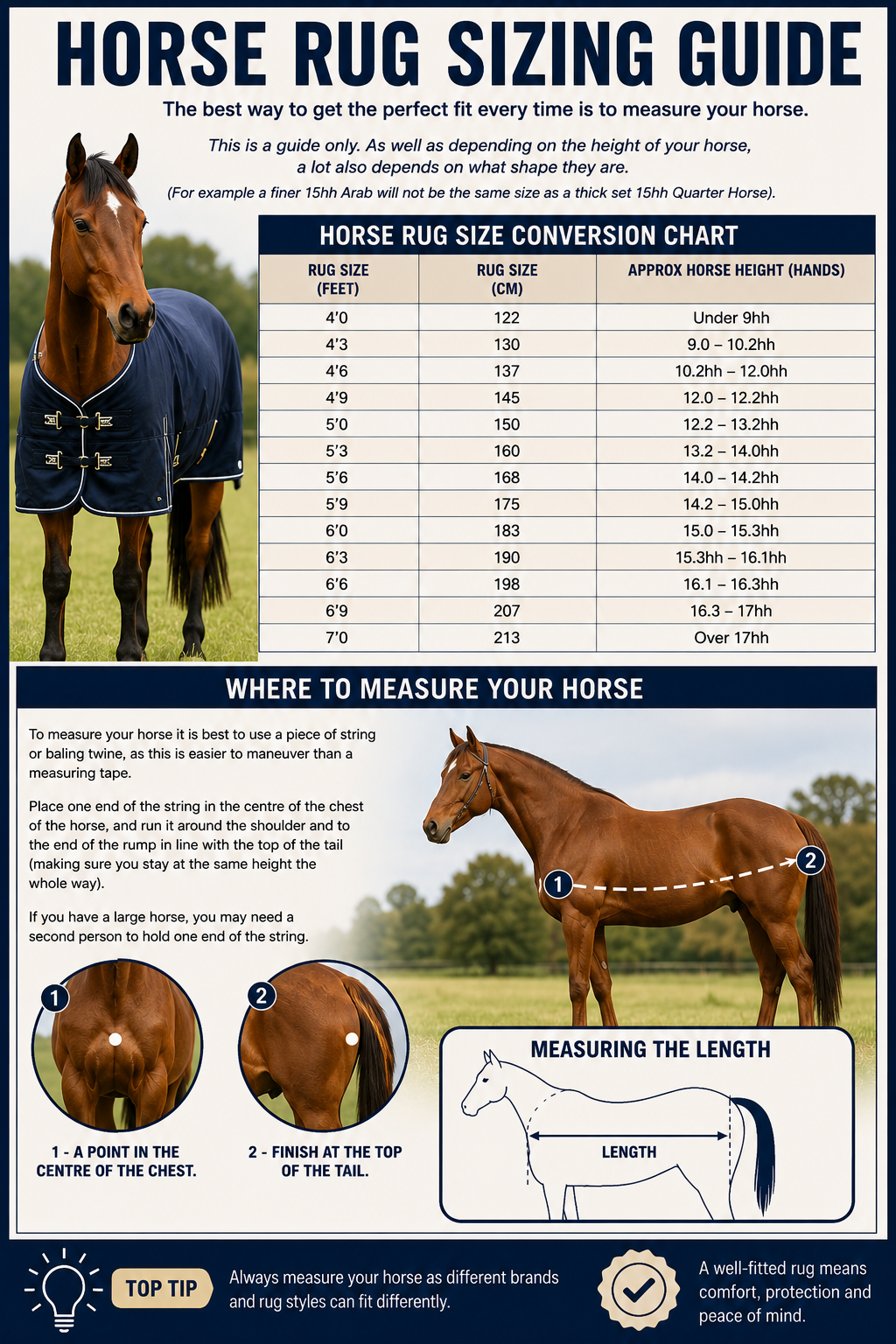
Choosing the right horse rug starts with one simple measurement: from the centre of the chest, around the widest part of the shoulder, along the side of the body to the centre of the tail. This measurement, taken in feet and inches, determines your rug size. Most Australian horses wear between 5’9 and 6’6, while ponies are generally 3’0 to 4’9 and larger warmbloods or thoroughbreds are often 6’9 to 7’0. A correctly sized rug will sit comfortably, stay in place and reduce rubbing, making your horse more comfortable all winter.
The one measurement that matters
What you need before you start
The step-by-step method
Here’s the exact sequence we walk through with customers who phone in unsure. It takes about ninety seconds with two people, a touch longer on your own. The three steps below mirror what the measuring diagram above is showing — chest, shoulder, tail — broken down so each one is hard to get wrong.
Three steps, one number
Do these three in order and the rug will fit on the first try
Step 1
Place the tape
Place the end of the tape measure in the centre of your horse’s chest, where the front buckles of the rug will sit.
Why it matters: the start point is the front edge of the rug. Two inches up or down here is two inches off the labelled size.
Step 2
Walk the line
Run the tape around the widest part of the shoulder, then continue it straight along the side of the body. Keep the tape following the horse’s shape without pulling it too tight.
Why it matters: a tape that floats above the body adds phantom inches. A tape that follows the curve gives the true rug-spine length.
Step 3
Read at the tail base
Continue the tape to the centre of the tail. The measurement in feet and inches is your horse’s rug size. For example, if the measurement is 6’3, you’ll need a 6’3 rug.
Why it matters: rug sizes are 3-inch jumps for a reason — anything finer than that gets lost in fit tolerance once the rug is on.
Tip: If your horse moves while you’re measuring—especially if they swing their hindquarters to one side—stop and measure again. Even a small movement can add an inch or two to the measurement, resulting in the wrong rug size.
It’s much better to take an extra minute to remeasure than end up with a rug that doesn’t fit properly.
Reading the number — feet and inches vs centimeters
Australian horse rugs are sized in feet and inches, while some European and American brands use centimeters. At Wholesale Horsewear House, all of our rugs are sized in the Australian standard. For example, a 6’3 rug is approximately 190 cm, a 6’6 is 198 cm, and a 7’0 is 213 cm. Remember, 6’3 means 6 feet 3 inches, not 6.3 feet. If you’re unsure how to convert your measurement or choose the right size, simply give us your measurement and we’ll help you find the perfect fit.
The Wholesale Horsewear House size chart — 3’0 to 7’0
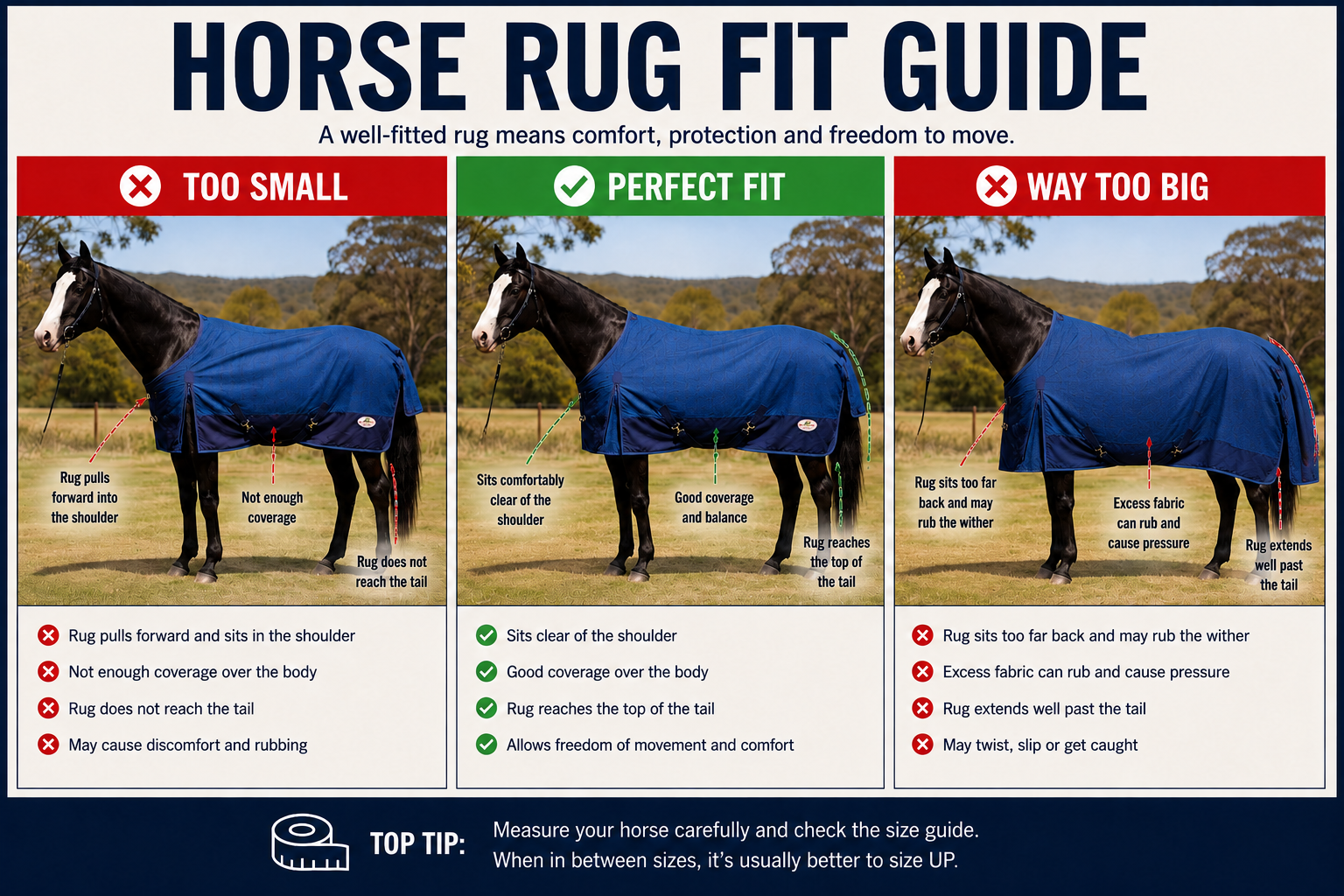
We carry sizes from 4’6 to 7’0 across most of the range — far more sizing depth than most competitors — because a pony and a 17hh warmblood both deserve a rug that actually fits. Below is the cheat sheet our counter staff hand out to customers who phone in for sizing. Match your horse’s type to the row, take the tape measurement, and use that to choose the labelled size.
The four sizing mistakes we see every winter
Most fit problems aren’t bad rugs — they’re measurements done wrong. After two decades of phone calls from frustrated horse owners on a Friday afternoon, these are the four mistakes we see again and again. None of them are about being careless. They’re about following the wrong instruction the first time you measure and then sticking with it.
The mistakes that cost a winter
Four sizing errors we hear about every cold snap — and the fix for each
Mistake 1
Measuring the side only
People put the tape on the wither and run it back to the tail, skipping the chest and shoulder curve. That misses 4–6 inches. The rug arrives a size too small, rides up the rump, and rubs the shoulders.
Mistake 2
Sharing across two horses
“They’re about the same size” — never true. Two horses an inch different in body length will fit two different rug sizes. Measure each horse separately, even if they’re paddock mates.
Mistake 3
Buying for the lighter horse
If two horses share a rug and you size for the smaller one, the rug strangles the bigger horse’s shoulder. Size for the larger horse and accept the smaller will have a little extra at the tail.
Mistake 4
Ignoring shoulder gusset depth
Two rugs at 6’3 can fit very differently because the shoulder gusset — the panel that lets the shoulder rotate — can be shallow or deep. Broad-chested horses need deep gussets; phone us if unsure.
When you’re between two sizes
If your horse measures between standard rug sizes (for example 6’1, 6’4 or 5’10), you’ll need to choose whether to size up or down.
Choose the larger size if your horse is clipped, has sensitive skin, is an older horse, or you’re buying a heavier winter rug such as a Perisher, Arctic, or Husky. A little extra room is usually more comfortable and allows for winter coat changes and natural movement.
Choose the smaller size if your horse is broad through the chest, you’re buying a lightweight summer or fly rug, or your horse tends to lose condition over winter and you prefer a snugger fit.
If you’re ever unsure, we generally recommend sizing up. A slightly larger rug can usually be adjusted with the chest straps, surcingles and leg straps, while a rug that’s too small can’t be made bigger. A little extra room is almost always preferable to a rug that’s too tight.
Wholesale Horsewear House — phone us if in doubt
We’re a family-run saddlery at 8/24 Carroll St, Toowoomba, founded by Geraldine Lalor in 2005. We design the GTL rug range ourselves and ship every order from our Toowoomba warehouse — and GTL is now stocked at saddleries across Australia and New Zealand. Twenty years of measuring up Australian horses behind the counter means we’ve seen every body shape, every breed, every awkward in-between size. If your tape measurement lands somewhere odd, or your horse has an unusual build, phone us on (07) 4613 5599 and we’ll talk it through.
Related reading from the Wholesale Horsewear House Horse Rugs guide
Measuring is one piece of the rug decision. We’ve covered the other pieces of the same puzzle in companion guides — weight, neck cover, durability, and rugs for sensitive horses — below.
What weight horse rug do I need? An Australian climate guide
The companion piece to this one. Once you know what size to buy, you need to know what weight — light, medium, heavy, or arctic. We break it down by Australian climate zone, with the right rugs from our range for each.
Rug vs combo: when do you need the neck cover?
A combo covers the neck; a rug doesn’t. The choice depends on where you live, whether the horse is paddocked or stabled, and how much wind and rain you get. We explain when the extra neck cover earns its keep.
How long does a quality horse rug last?
A well-fitted GTL or Highlander combo routinely lasts four to six winters on a paddock horse. Stable rugs last longer. We cover what shortens the life of a rug — and the maintenance habits that double it.
Best horse rugs for sensitive-skinned horses
Sensitive horses, thin-skinned thoroughbreds, and horses recovering from rain scald all need a rug that breathes well and sits soft on the coat. We walk through the rugs from our range that suit those horses best.
Browse the full Wholesale Horsewear House horse rug range
From minis at 3’0 through to warmbloods at 7’0, our entire horse rug catalogue is in one place. Filter by weight, neck cover, or size — or phone us on (07) 4613 5599 if you’d rather we picked one for you.
Sources
Guidance in this article reflects the typical experience of Australian horse owners across the WHWH customer base and is intended as general sizing information for horses in normal body condition. Individual horses vary — broad-chested horses, deep-shouldered horses, older horses, and horses with unusual builds may need a different approach. If in doubt about your specific horse’s measurement, speak with your saddlery or call us on (07) 4613 5599 and we’ll talk you through it.